So, I have to admit something. I didn’t do anything with the Miata’s alignment after lowering the car considerably. Tire wear didn’t come across my mind often because it’s one of those things that takes time. I lived with the handling being fairly squirrely because it did feel responsive. Maybe just a little too responsive. The toe was out in front. Enough that a person could tell by just looking at where the wheels pointed. It was time to fix things.

The decision was made to change the tie rod ends for something that would help reduce the negative characteristics from lowering the car. Adjustable tie rod ends would help at least with the change in toe occurring when turning and traveling over uneven road.
The original tie rod end is above. That’s what I like about this car. It’s a clearly worn part, not beat to junk, not rusted in half, but obviously in need of service considering the boot is no good. Simple.
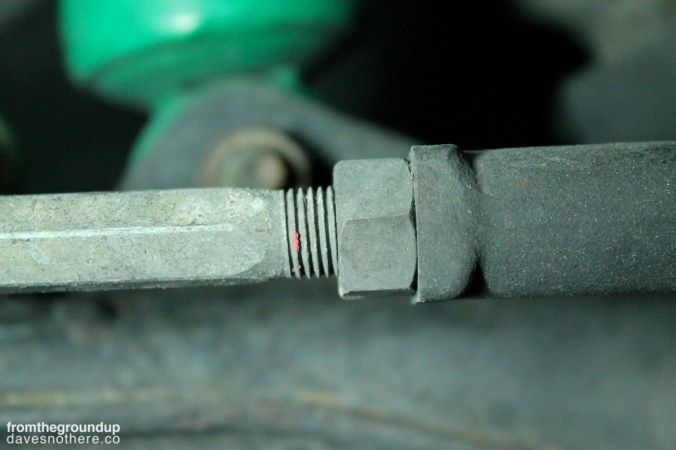
I measured things out. I counted the number of threads visible. If nothing else, it would at least be close to right.
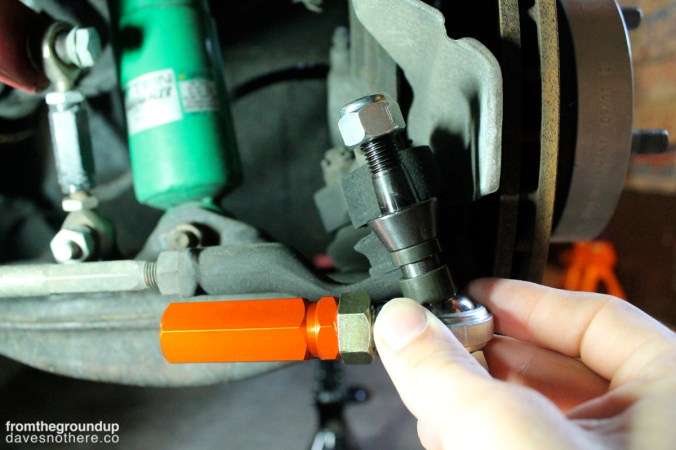
Here’s the new tie rod end on the driver’s side. It’s an adjustable part made for an RX-7, but the threads are the same as the MX-5. You can see how much farther down the new ends would bring the inner tie rods. So much better.

After driving around with the new tie rod end improvement, I decided to swap out the power steering rack for the manual version. The power steering would get in the way of the turbo stuff. Also, I can always justify in my mind a change to the car if it saves weight, even if it’s a laughably small difference.
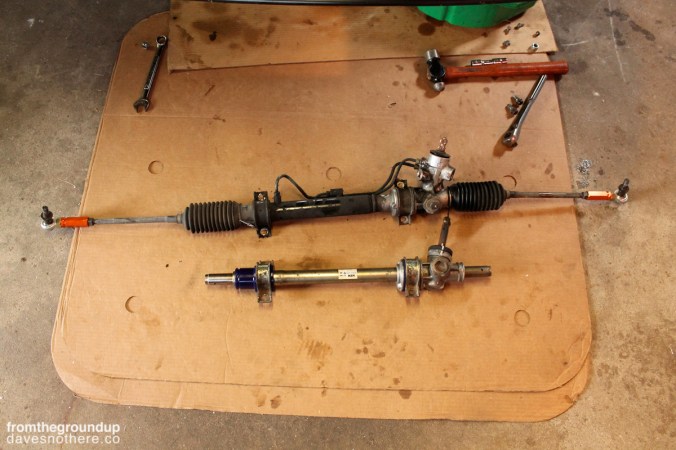
It was a fun project. Not too difficult. I sourced a manual rack through Panic Motorsports. Great company. I called since it wasn’t on the site. They said they thought they just got one in and called back very shortly thereafter to confirm. The price was right and two days later I had a manual rack. I went with SuperPro bushings to mount the rack. They’re marginally stiffer than stock rubber bushings.
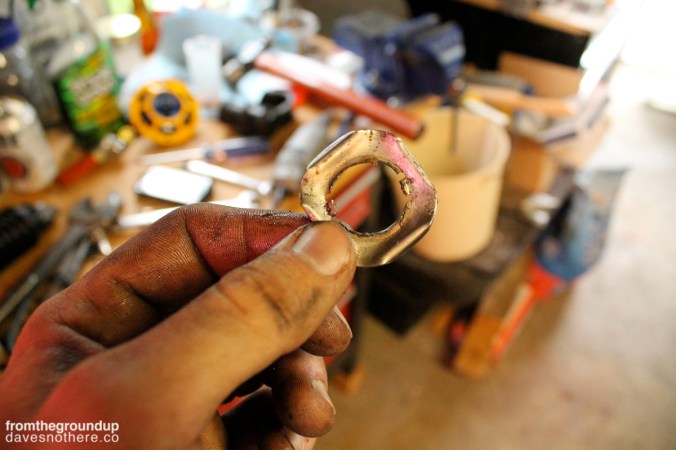
I did have to modify these parts for use on the manual rack. They’re from the power steering rack, but I made them work on the manual rack. I did use the dremel around the inside to make the holes large enough to work. In the end, the tabs still bent in as they were meant to. If time didn’t matter, I would have ordered the correct parts. However, I had scheduled an alignment at a race shop outside Chicago called TF Works. I didn’t leave myself any time to spare.
After the tie rod end swap and the alignment, the car was handling much better. It was not as unpredictable. It responded very well to small steering inputs, but less frantically.
 From The Ground Up